



Keven Talks Sails: Mast Bend explained
Apr 22, 2021
Everyone is always talking about mast bend; what is it, and what does it do?
There are two types of mast bend. Fore and aft bend, and sideways bend.
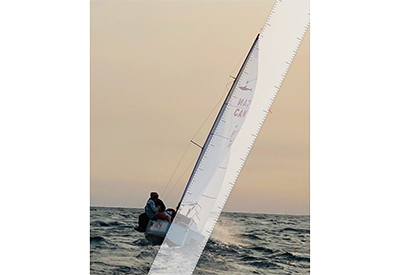
Sideways bend, in the below photo, is the least common type of bend that sailors talk about, unless they are in some particular racing classes where it can help tune the sails. In those classes, you are at most looking at 30mm of side bend either to windward or leeward.
Below is a shot of a Shark with a very side bent mast. The mast appears to be hanging tight on the lower shrouds. This dramatically reduces the strength of the mast and increases the chance of buckling. This is what you should try to avoid on most boats. Some tip falloff of an unsupported top mast is ok, but a major and unfair side bend will lead to trouble.
Most of the time you are looking for the mast to be well supported from the shrouds to have minimal side bend.
a shot of a Shark with a very side bent mast
This is a more common sidebend that is expected. Notice it is relatively straight and the mast stays in column.
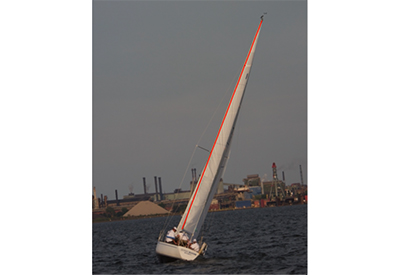 This is a more common sidebend that is expected.
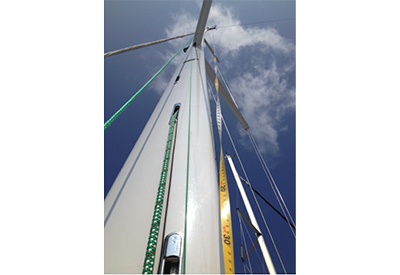
Fore and aft bend is the most common mast bend to discuss. You can look up a mast and see the bend without your tensioning devices on, and this is the prebend of the mast. Tension up the backstay adjuster, and other mast bend tools and see what the maximum bend is. This is your max bend. Sailing bend is between those ranges and where your sail luff curve should be designed for.
This shows the prebend of a particular rig, a very modest amount, but enough that it has to be accounted for by the sailmaker to get a good fitting sail.
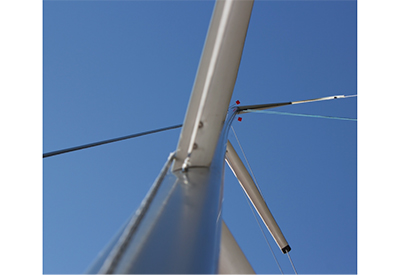 This shows a 40’ performance cruising mast and a fairly significant amount of maximum bend, the point where the mainsail is expected to be trimmed to the flattest shape.
So what does this mast bending do? Check out the YouTube video below. It shows the mesh shape of a mainsail, and the moving purple lines are the camber stripes of the sail. As the mast gets straighter, the sail gets fuller by forcing more sailcloth into the shape of the sail. When the mast is bend more, the sail flattens out as cloth is pulled out of the shape of the mainsail.
{youtube}HqYRrG2L8Uw{/youtube}
What shall we discuss next month? I’m thinking that headstay sag is an interesting topic.
 Keven Piper – Sailmaker, Bay Sails, Hamilton, Ontario
Keven Piper, two-time Shark 24 World Champion, founded Hamilton, ON-based Bay Sails in 1998.
email: baysails@gmail.com